
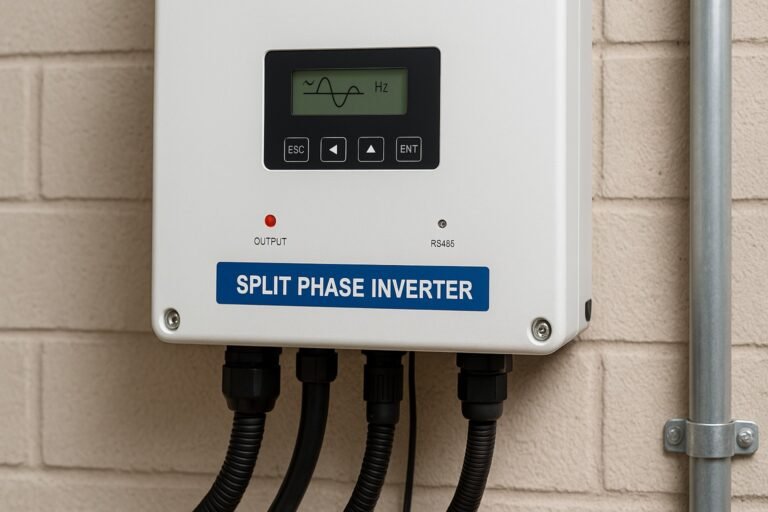
If you’ve ever looked into powering your home with solar energy or setting up an off-grid system, you’ve probably come across the term split phase inverter. At first, it might sound like complex electrical jargon, but it’s actually one of the most practical technologies behind how modern solar and hybrid power systems deliver electricity safely and efficiently. In simple terms, a split phase inverter is designed to provide both 120 V and 240 V power outputs—the same type of power that most homes in the U.S. use. This makes it ideal for running everything from standard outlets and lights to high-demand appliances like dryers, air conditioners, and EV chargers.
Here’s the thing—choosing the right inverter isn’t just about wattage or price; it’s about compatibility, reliability, and efficiency. That’s why understanding what a split phase inverter does, how it differs from single-phase models, and which voltage versions (like 24 V, 48 V, or 120/240 V) fit your setup can make all the difference. Throughout this guide, we’ll break down how split phase inverters work, their types (including hybrid inverter chargers), and the key factors to consider before installing one. Whether you’re a solar enthusiast, a homeowner exploring energy independence, or just curious about how your power system operates, this article will give you clear, practical insights—without the technical confusion.
What Is A Split Phase Inverter?
Definition & Basic Concept
In simple terms, split phase refers to a type of electrical power distribution commonly used in North America, where electricity is supplied as two hot wires that are 180 degrees out of phase with each other and share a single neutral wire. Each hot leg provides 120 volts relative to neutral, but when combined, they create a 240-volt circuit between the two hots. This dual-voltage setup allows homes to efficiently run both standard 120 V devices (like lights and outlets) and heavier 240 V loads (like stoves, dryers, and HVAC units).
A split phase inverter is designed to replicate this exact configuration when converting DC (direct current) power—usually from batteries or solar panels—into AC (alternating current) power for household use. Instead of producing just a single 120 V output like a standard inverter, it generates two 120 V outputs that are opposite in phase, delivering a combined 120/240 V AC output. In simpler words, it lets you power all types of household appliances from one system, whether they need low or high voltage.
How It Differs From A Single-Phase Inverter
A single-phase inverter produces one AC output consisting of a single hot wire and a neutral. This configuration can only deliver 120 V power, which works perfectly for lights, small electronics, and most outlets but can’t handle larger 240 V appliances.
A split phase inverter, on the other hand, has two hot outputs and one neutral, each leg providing 120 V while combining to supply 240 V when needed. This extra flexibility makes it far more suitable for whole-home energy systems or hybrid solar setups.
Key differences at a glance:
- Single-phase inverter → 120 V output only
- Split phase inverter → 120/240 V output options
- Single-phase systems → simpler wiring, limited appliance compatibility
- Split phase systems → handle both light and heavy-duty loads efficiently
- Split phase also allows load balancing across both legs for improved system stability
Why It Matters In Residential & Solar Systems
For homeowners and solar installers, the split phase inverter offers a practical way to power everything under one roof without relying on multiple inverters or transformers. Most U.S. homes are wired for 120/240 V service, meaning a split phase inverter integrates seamlessly with standard electrical panels. It’s especially useful for off-grid systems or hybrid solar setups where the user needs to run both low-voltage lighting circuits and high-voltage equipment like air conditioners, water pumps, or electric dryers.
On top of that, it helps balance loads more efficiently between the two phases, reducing power strain and improving performance. For solar enthusiasts or off-grid homeowners, investing in a split phase inverter means greater compatibility, flexibility, and peace of mind—since the system mirrors what utility companies already deliver to residential properties.
Typical Voltage Configurations & Labels
120 / 240 Vac Split Phase Systems
In most U.S. homes, electricity is supplied as 120 volts line-to-neutral and 240 volts line-to-line. This setup is known as a 120/240 V split phase system, and it’s the standard for residential power distribution. The two hot wires, or “legs,” each carry 120 V relative to the neutral wire but are 180 degrees out of phase with each other. When you measure the voltage between the two hot legs, it adds up to 240 V.
For inverters, this configuration means that a 120/240 split phase inverter can power both types of appliances simultaneously. Smaller devices like lamps and TVs use the 120 V circuits, while large appliances—such as ovens, HVAC units, and well pumps—draw 240 V directly from the inverter’s combined output. This flexibility is what makes split phase inverters particularly valuable for homes that run a mix of low and high-voltage equipment.
24 V, 48 V, And Even 12 V DC Input Versions
Split phase inverters can operate from different DC input voltages, depending on the type of power source or battery bank they’re connected to.
The most common configurations are 12 V, 24 V, and 48 V DC systems.
- A 12 V split phase inverter is typically used for small off-grid setups, such as RVs, boats, or tiny homes, where lower voltage systems are easier to manage.
- A 24 V split phase inverter suits medium-sized solar or backup systems, providing better efficiency and reduced current losses compared to 12 V systems.
- A 48 V split phase inverter is ideal for large residential or commercial applications. It offers higher efficiency, less heat generation, and supports more powerful loads, making it the preferred choice for modern solar and hybrid installations.
In simple terms, the higher the DC input voltage, the more efficient the inverter tends to be, especially in setups that involve high power demand or long cable runs.
Hybrid Inverter Chargers & Their Role
A split phase hybrid inverter or split phase inverter charger takes versatility to the next level. These devices combine multiple functions in one unit—they work as an inverter, a battery charger, and often as a solar charge controller or grid-tie interface. Essentially, they allow energy to flow intelligently between solar panels, batteries, and the utility grid, depending on the situation.
When the grid is available, the inverter charger can draw AC power to recharge the batteries. When the grid goes down, it automatically switches to battery or solar power to keep essential circuits running. Some advanced hybrid models even support seamless transitions between power sources, ensuring uninterrupted electricity.
This flexibility makes hybrid split phase inverters particularly valuable for homeowners seeking both energy independence and grid reliability—especially in areas with frequent outages or where solar energy plays a major role in daily consumption.
How A Split Phase Inverter Works (Technical Insight)
Internal Topology & Phase Splitting
At its core, a split phase inverter works by converting direct current (DC) from a battery bank or solar array into alternating current (AC) power suitable for home use. The process starts when DC power flows through a switching stage, where high-speed electronic switches—like IGBTs or MOSFETs—rapidly turn the current on and off. This high-frequency switching produces a waveform that, once filtered, becomes clean, stable AC output.
After the initial conversion, the inverter either uses a center-tapped transformer or an electronic phase-splitting method to create two identical AC outputs that are 180 degrees out of phase with each other. This phase difference is what generates the 120/240 V configuration, allowing the inverter to replicate the same type of power you’d receive from the utility grid. In modern designs, digital signal processors (DSPs) or microcontrollers precisely manage this process to maintain consistent voltage, frequency, and phase balance.
Inverter Output: Two “Legs” 180° Out of Phase
The defining characteristic of a split phase inverter is its dual output legs. Each leg provides 120 volts relative to the neutral wire, but because they are 180 degrees out of phase, the voltage measured between them is doubled—resulting in 240 volts.
This setup allows the inverter to supply two kinds of power simultaneously:
- 120 V AC for standard outlets and smaller loads
- 240 V AC for heavy-duty appliances such as stoves, water heaters, and EV chargers
By alternating the direction of the current in each leg, the inverter ensures both balanced power distribution and compatibility with U.S. residential systems, making it extremely versatile.
Key Components & Control Features
Inside a high-quality split phase inverter, you’ll find power transistors (IGBTs or MOSFETs) that handle the fast switching needed to convert DC to AC efficiently. Filter capacitors and inductors smooth the waveform, ensuring it’s a clean, pure sine wave suitable for sensitive electronics. Some advanced models use split inductors or separate filtering stages for each leg to improve output stability and reduce harmonics.
However, because split phase designs involve dual outputs and high switching frequencies, they can experience spike currents and electromagnetic interference (EMI) if not properly engineered. This is why good inverter design includes shielding, snubber circuits, and high-quality filters. The control system continuously monitors voltage and phase to prevent distortion and maintain balanced output between both legs, even when loads are uneven.
Real-World Example: 10 kW Split Phase Inverter Setup
Imagine a 10 kW split phase inverter installed in a home with a solar-plus-battery system. The inverter takes DC power from a 48 V lithium battery bank and solar panels, then delivers 120/240 V AC power to the home’s electrical panel. The 120 V legs run everyday items like lighting, TVs, and kitchen appliances, while the 240 V output powers the dryer and air conditioner.
If the grid is connected, the inverter can synchronize with utility power, feeding excess solar energy back into the grid. In off-grid mode, it automatically switches to battery or solar input, ensuring continuous operation. This combination of performance, flexibility, and reliability makes split phase inverters essential for homes aiming for energy independence or backup power stability.
Single Phase Vs Split Phase Inverter: Which One To Choose?
Key Differences At A Glance
To make things clearer, here’s how a single-phase inverter compares to a split phase model:
| Feature | Single-Phase Inverter | Split Phase Inverter |
| Output Voltage | 120 V only | 120/240 V |
| Number of Hot Wires | 1 | 2 (180° out of phase) |
| Neutral Connection | Yes | Yes |
| Compatible Loads | Light to moderate | Light and heavy (combined) |
| Wiring Complexity | Simple | Moderate |
| Use Case | Small systems or specific loads | Whole-house or hybrid systems |
| Cost & Efficiency | Lower cost, limited use | Higher cost, greater flexibility |
When A Single-Phase Inverter Suffices
A single-phase inverter is perfectly fine for smaller or simpler applications. If you’re powering a cabin, RV, or small off-grid setup that only requires 120 V circuits, a single-phase unit is efficient, affordable, and easier to install. These systems typically don’t have heavy 240 V appliances, so there’s no need for phase splitting or dual outputs.
When A Split Phase Inverter Is Better
For most modern homes—especially in the U.S.—a split phase inverter is the smarter choice. Many essential household appliances run on 240 V, including dryers, ovens, well pumps, and electric vehicle chargers. Using a split phase system means you can power everything through one inverter without installing separate systems or transformers. It also helps balance power loads between both legs, improving overall efficiency and stability.
In short, if your home has mixed voltage needs or you plan to integrate solar panels and batteries, a split phase inverter offers far more flexibility and long-term scalability.
Considerations For Solar And Hybrid Systems
For solar professionals, installers, or brand managers evaluating new inverter technologies, it’s crucial to match the inverter’s capabilities with the home’s load profile and future energy goals. A split phase hybrid inverter offers compatibility with grid, solar, and battery inputs—making it ideal for U.S. households transitioning toward sustainable power solutions.
Inverters should be selected not only for power rating but also for efficiency, waveform quality, and service reliability. It’s also important to plan for system expansion—choosing a split phase inverter now can save time and cost later when adding larger loads or upgrading to a full hybrid system.
Key Technical Specs & What To Look For
Input Voltage & Output Configuration
Start by matching the DC side to your battery or PV design: most residential split phase inverters accept 24 V or 48 V DC (12 V exists for small systems but limits power and raises cable current), and produce 120/240 V AC split phase on the output so you can run both standard 120 V circuits and heavy 240 V loads; in practice, 48 V DC is the sweet spot for homes because it keeps currents lower, reduces copper size and heat, and gives you headroom to scale without stressing the inverter.
Continuous Power Rating & Surge Capacity
Look beyond the headline wattage and check both continuous and surge ratings: a “10 kW split phase inverter” should comfortably supply 10 kW at typical ambient temperatures while also delivering short bursts (often 2× for a few seconds or 1.2–1.6× for 10–30 s) to start motors and compressors; if you’ll run well pumps, HVAC, or tools, confirm the starting amps of those loads and ensure the inverter’s surge curve and breaker sizes can handle them without nuisance trips.
Efficiency, THD (Total Harmonic Distortion), Waveform Quality
High-quality units achieve >96 % peak efficiency and <3 % THD on the AC output, which matters for sensitive electronics, cooler operation, and lower utility interaction losses; advanced designs use fast switches with robust filtering to minimize switching spike currents and EMI, so when comparing datasheets, prioritize published efficiency maps (not just peak), THD across load levels, and any mention of EMI mitigation or “clean sine” under asymmetric (unbalanced-leg) loading.
Protection Features & Grid-Tie Capabilities
Must-have protections include over/under-voltage, over-current, short-circuit, over-temperature, ground-fault, and for grid-interactive models, certified anti-islanding with proper frequency/voltage ride-through; if you plan to export solar, verify grid codes (e.g., UL 1741/IEEE 1547 family), rapid shutdown support where required, and whether the inverter can black-start and form a stable microgrid for backup loads without the utility present.
Compliance, Warranty & Brand Reliability
Compliance marks (UL/CSA/CE as applicable), 5–10 year warranties with clear workmanship and parts coverage, and an accessible service network are as important as specs; from a brand-management perspective, evaluate vendors on documented failure rates, firmware update cadence, local RMA turnaround, installer training, and spare-parts availability—prioritize manufacturers that publish transparent test data and provide design tools, because those traits correlate strongly with lower lifetime support costs.
Installation & Practical Considerations
Wiring & Panelboard Setup
In a split phase system the inverter feeds two hot legs (L1/L2) 180° out of phase plus a shared neutral into a sub-panel or main panel, giving 120 V line-to-neutral and 240 V line-to-line; keep high-draw 240 V loads on two-pole breakers and distribute 120 V branch circuits across both legs to balance current, which reduces neutral heating and voltage sag, and always size conductors, over-current protection, and bonding/grounding to code with torque-spec’d lugs and proper labeling.
Battery & Solar Integration
Choose 48 V batteries for most homes to limit DC currents and cable losses, size the battery in kWh to your evening/backup needs, and confirm the inverter’s PV input limits (max DC voltage/current, MPPT range) if it has built-in solar tracking; in hybrid setups define operating modes—self-consumption, time-of-use shifting, backup reserve—and set charge/discharge limits, temperature compensation, and BMS communications so the system behaves predictably under grid outages and daily cycling.
Cooling, Ventilation & Placement
Mount the inverter indoors or shaded, off the floor, with clearances per the manual so fans and heat sinks can breathe; avoid dusty, corrosive, or high-humidity locations, keep intake paths clean, and remember that every 10 °C rise shortens component life—so good airflow, neutral-colored walls (less radiant heat), and avoiding attic-level temperatures materially improve reliability.
Maintenance & Monitoring
Plan a simple routine: quarterly visual checks for discoloration or loose terminations, vacuuming of vents/filters, verify firmware is current, and review the monitoring portal for leg balance (L1 vs L2), unusual THD, repeated faults, or derating events during hot days; logging start-up currents of large appliances and keeping a record of system changes helps you troubleshoot quickly if lights flicker or breakers nuisance-trip.
Cost Vs Benefit: Realistic Expectations
Split phase inverters usually cost more than single-phase models, but the premium buys you 120/240 V flexibility, simpler whole-home integration, and fewer workarounds (no external transformer, fewer compromises on large loads); if you have—or plan to add—240 V appliances, EV charging, or a well pump, the total installed cost often pencils out because you avoid piecemeal upgrades and get a system that’s ready for future demand.
Common Myths & Less-Known Facts
Myth: “Any single-phase inverter will work in a split-phase system.”
That assumption leads to headaches later. A true split phase inverter is purposely designed to create two synchronized 120 V legs 180° apart so you can get both 120 V and 240 V outputs. A regular single-phase inverter only generates one 120 V leg; if you connect it to a split-phase panel, half the breakers won’t energize, and you risk overloading one side or damaging equipment. The correct approach is to use a dedicated split-phase or transformer-coupled inverter that’s UL-listed for 120/240 V service.
Less-known fact: During rapid switching and phase balancing, spike currents and EMI can appear inside split-phase topologies. High-frequency transitions between the two legs can induce momentary current peaks that stress components and raise noise. Well-designed inverters counter this with careful gate-drive timing, snubber circuits, and advanced filtering. Cheaper designs may skip these protections, so always review EMI compliance and waveform quality in the specs.
Pro Tip: If your home currently has a single-leg 120 V panel but you plan to install 240 V appliances later—say, an electric dryer or EV charger—upgrade to a split phase inverter now. It future-proofs your system and spares you expensive rewiring or transformer add-ons.
Expert Advice: Always balance the loads between the two hot legs (L1 and L2). Uneven loading sends extra current through the neutral and wastes capacity. Keeping both legs within about 10 % of each other’s load helps the inverter run cooler, maintain stable voltage, and extend component life.
Use-Case Scenarios & Sizing Guide
Off-Grid Cabin With 24 V Battery & Split Phase Inverter
For a small off-grid cabin, you might use a 24 V battery bank feeding a 3–5 kW split phase inverter. Start by listing every appliance: lights and outlets on 120 V circuits, plus a 240 V water pump or mini-split AC. Estimate total daily energy use (in kWh), then size the battery at roughly 1.2–1.5 × that value for reserve capacity. Choose solar panels that can fully recharge the bank in 4–6 hours of good sun. This setup gives full household functionality with minimal compromise—quiet, efficient, and independent.
Grid-tied Solar Home In The U.s. With 10 Kw Split Phase Inverter
In a suburban U.S. home, a 10 kW split phase inverter can handle both grid interaction and backup power. Pair it with a 10 kW PV array and a 48 V lithium battery. When the grid is up, the inverter synchronizes at 120/240 V, exports surplus energy, and keeps batteries topped up. During outages, it isolates itself and powers the main panel or a dedicated backup sub-panel. Homeowners get seamless operation—lights, refrigerator, and even 240 V HVAC keep running—demonstrating the inverter’s flexibility and resilience.
Retrofit Of Existing Panel With Split Phase Hybrid Inverter
For older homes wired with basic 120 V panels, a split phase hybrid inverter retrofit offers a strong upgrade path. Electricians can reconfigure the service to dual-leg operation and integrate solar plus storage without a full rewire. From a brand-management or product-placement viewpoint, this retrofit angle is valuable: it lets you market modern energy solutions to homeowners who thought solar was impossible without rebuilding their electrical system. Positioning it this way—“upgrade your power, not your house”—helps bridge innovation with practicality.
Conclusion
Choosing the right inverter type is one of the most important decisions in any solar or backup power setup. A split phase inverter stands out because it mirrors the same 120/240 V structure used in modern homes, making it ideal for both light and heavy electrical loads. Unlike single-phase models, it delivers the flexibility to run standard electronics and high-demand appliances from the same unit, while maintaining balanced power across circuits. For homes, businesses, or off-grid systems planning long-term energy independence, that balance of efficiency and adaptability is what makes the split phase design so valuable.
When evaluating your options, consider not just the power rating but also the finer details—input voltage, surge capacity, waveform quality, safety certifications, and manufacturer reliability. A good inverter should deliver clean power, integrate easily with batteries or solar panels, and last for years with minimal maintenance. By reviewing these key factors before purchasing, installers and homeowners alike can ensure they’re investing in a system that’s safe, future-ready, and perfectly aligned with the way modern electrical systems operate.
FAQ’s:
Can I Use A Single-Phase Inverter And Still Have 240 V Output?
Not directly. A single-phase inverter only provides one 120 V leg, so it can’t naturally create the 240 V output needed for large appliances. To achieve 240 V from a single-phase inverter, you’d need an external step-up transformer or a special wiring configuration—but that adds cost, complexity, and energy loss. A split phase inverter already provides both 120 V and 240 V outputs, making it the safer and more efficient choice for U.S. residential systems.
What Are The Main Benefits Of A Split Phase Inverter Over A Regular Single-Phase Type?
A split phase inverter offers dual output voltages—120 V and 240 V—allowing it to power everything in a home, from lights to heavy-duty appliances. It also ensures better load balancing between electrical circuits, improved efficiency, and full compatibility with standard U.S. household wiring. Essentially, it gives you the same kind of power you’d get from your utility company but from your solar or battery system instead.
Is A 24 V Input Split Phase Inverter Less Efficient Than 48 V?
Yes, generally. A 48 V input inverter operates at lower current levels for the same power output, which reduces heat loss, improves conversion efficiency, and extends the lifespan of components. A 24 V inverter is still reliable for smaller systems but becomes less practical as power demand increases. For most modern homes or hybrid systems, 48 V is the preferred and more future-proof option.
How Do I Ensure My Loads Are Balanced Across Both Legs Of A Split Phase System?
To balance loads, distribute 120 V circuits evenly between the two hot legs (L1 and L2). Heavy or continuous loads like air conditioners or refrigerators should be spread across both sides so neither leg carries significantly more current. Many advanced inverters also include monitoring tools that show leg-specific current draw, helping you fine-tune balance and reduce neutral current for better efficiency.
Can I Retrofit A Split Phase Inverter Into An Existing 120 V Only Panelboard?
Yes, but it requires careful planning. Electricians can often reconfigure or replace the existing panel with a split phase-ready subpanel that supports both 120 V and 240 V circuits. This upgrade allows you to add larger appliances later without overhauling the entire system. Retrofitting with a split phase hybrid inverter is an excellent way to prepare an older home for solar or battery expansion while keeping installation costs reasonable.
Disclaimer
The information in this article is for general educational purposes only and should not be taken as professional electrical or installation advice. Always consult a licensed electrician or certified solar installer before purchasing, wiring, or modifying any inverter system.
