
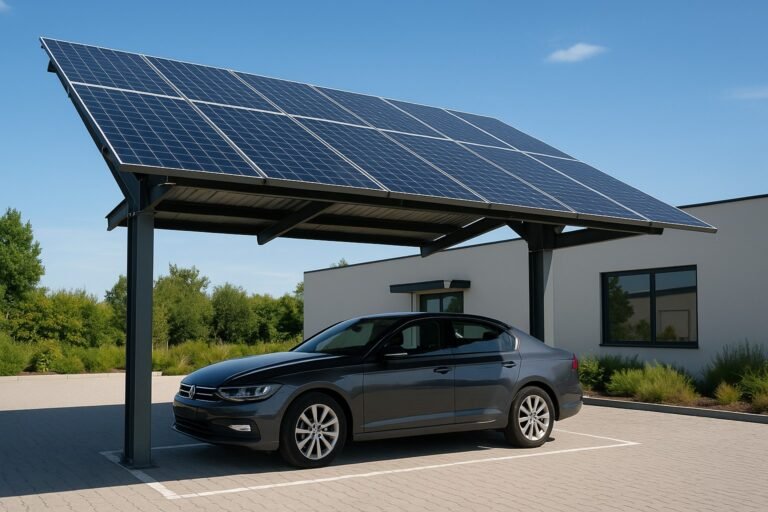
A solar carport is a simple idea that solves two needs at the same time: it provides a covered parking space and uses that same structure to generate clean electricity through solar panels. Instead of placing panels on a roof, the canopy above the car becomes the power source. This design makes a solar carport a practical option for homeowners who don’t have a suitable rooftop, and for businesses that want to turn their open parking areas into useful energy-producing spaces.
What makes a solar carport especially appealing is how flexible it is. Residential users like it because it offers shade, helps protect their vehicles from heat, and can power part of their home. Commercial users often look at it as a long-term investment that reduces electricity bills, supports sustainability goals, and prepares them for future EV charging needs. Many modern systems also allow you to add battery storage, which means your solar carport can store extra energy for nighttime use or backup power during outages.
Of course, many people also want to understand what a solar carport costs, how much energy it can produce, and whether it’s worth choosing over a rooftop installation. This guide breaks everything down clearly. You’ll find expert insights, practical examples, and real-world considerations — all explained in a friendly and easy way — so you can decide whether a solar carport is right for your home, business, or long-term energy plans.
Understanding The Solar Carport Concept
A solar carport is essentially a parking structure designed with solar panels mounted on top, allowing it to serve as both a protective canopy and a clean energy generator. The idea has become popular because it turns underused parking areas into productive energy assets without relying on roof strength or open land. As more homeowners and businesses look for smarter ways to manage space and energy, the solar carport offers a practical, flexible, and future-ready solution.
What Is A Solar Carport?
A solar carport is a raised canopy built specifically to support solar panels while providing shade for vehicles. Unlike a traditional carport, which only offers shelter, this structure is engineered to hold photovoltaic (PV) modules, wiring, and electrical components that feed power into your home, business, or the grid. It works the same way as any solar system, but the panels sit above the parking area rather than on a roof or open field.
For many users, the appeal comes from its dual function — vehicle protection and dependable solar power — all in the same footprint.
Solar Carport Vs Rooftop And Ground-Mounted Solar Panels
A solar carport differs from rooftop systems because it doesn’t depend on roof condition, direction, or available space. If your roof is shaded, aging, or not structurally ideal, a carport bypasses those limitations. The tilt angle on a carport can be optimized more accurately, which often results in better yearly energy production.
Compared to ground-mounted solar, a solar carport uses space more efficiently. Ground mounts usually need open land dedicated solely to the system, while a carport simply upgrades the parking area you already use. For commercial sites with large parking lots, this means energy generation without sacrificing usable land.
Why Consider A Solar Carport For Residential Or Commercial Use
A solar carport fits both residential and commercial needs, but for different reasons.
For homeowners, it offers shade, heat reduction, and a cleaner way to power appliances or charge an EV. It also solves a common rooftop issue: not everyone has a roof that faces the right direction or is strong enough to carry panels. The carport becomes an independent power structure that doesn’t rely on the home’s architecture.
For commercial properties, the motivation is often strategic. Businesses can lower operational costs, support sustainability goals, and prepare their parking areas for EV charging stations. Solar carports also help companies improve their public image by showing visible investment in clean energy. For some businesses, the structure itself becomes a long-term asset that generates consistent savings year after year.
Key Components Of A Solar Carport System
A complete solar carport system includes several essential parts that work together to produce safe, reliable electricity:
- Canopy structure: The steel or aluminum frame that supports everything. It must withstand wind, rain, and long-term loads from solar panels.
- Photovoltaic (PV) panels: These convert sunlight into direct current (DC) electricity.
- Inverters: They transform DC power into usable alternating current (AC) for your building or the grid.
- Mounting hardware: Rails, clamps, and brackets securely attach the panels to the canopy.
- Wiring and protection equipment: Includes conduits, combiner boxes, breakers, and grounding for safety.
- Optional battery storage: Allows excess energy to be stored for nighttime use or backup power, making the solar carport more versatile.
- EV charging integration (optional): A growing trend for both homes and commercial parking areas.
Each part plays a role in ensuring the carport produces stable, efficient, and long-lasting solar power.
How A Solar Carport Works
A solar carport works just like a regular solar power system, but the panels are mounted on a raised canopy instead of a roof. The structure supports the weight of the panels, keeps them at the right angle, and provides shading for the vehicles parked underneath. Electricity generated through the panels flows into an inverter, which converts it into usable power for your home or commercial building. From there, the system can feed your appliances directly, charge an EV, store energy in batteries, or send extra power back to the grid.
Although the system looks simple from the outside, it involves careful engineering, proper electrical design, and precise installation to keep it safe, efficient, and long-lasting.
The Canopy Structure And Mounting System
The canopy is the backbone of a solar carport. It’s built from strong, weather-resistant materials—usually galvanized steel or aluminum—to hold the solar panels securely and withstand wind, rain, and long-term exposure. The design can be single-slope, dual-slope, or cantilevered, depending on the space and project requirements.
The mounting system sits on top of the canopy and includes rails, clamps, and fasteners that lock the panels in place. Because the structure is engineered specifically for solar, the installer has full control over tilt angle, direction, and spacing, allowing the system to achieve optimal sunlight exposure throughout the year.
Photovoltaic Panels, Wiring And Inverter Integration
The photovoltaic (PV) panels are responsible for capturing sunlight and converting it into direct current (DC) electricity. This power moves through protected wiring down the structure and into the inverter.
The inverter plays a critical role: it transforms DC power into alternating current (AC), which is the type of electricity buildings use. Depending on the project size, the system may use string inverters, microinverters, or hybrid inverters. Commercial systems may also include combiner boxes, surge protection, and safety disconnects to keep everything running smoothly and safely.
All components must be properly grounded, routed, and protected to ensure long-term performance and compliance with electrical standards.
Optional: Solar Carport With Battery Storage And EV Charging
Adding battery storage turns a basic solar carport into a more flexible energy system. With batteries, excess daytime energy can be stored for use at night, during cloudy periods, or when the grid goes down. This option is especially attractive for homeowners who want backup power and for businesses that need to stabilise electricity demand or avoid peak-time charges.
EV charging is another common upgrade. Since the carport is already part of your parking space, integrating a charging station becomes a natural extension. Solar panels can power the charger directly or indirectly through the main electrical system. For commercial parking lots, combining a solar canopy with multiple EV chargers creates a modern, future-ready energy hub.
Site Orientation, Tilt, Shading, And Design Optimisation
The performance of a solar carport depends heavily on how it is positioned. The canopy should face the direction that receives the most sunlight—south-facing in many regions—though the optimal design varies by location.
Tilt angle is equally important. A properly angled carport helps the panels capture consistent solar energy throughout the year while allowing rainwater to flow off the surface.
Shading is another factor. Even partial shade from trees, poles, or nearby buildings can reduce production. A professional shading analysis is used to determine the best placement and avoid losses.
Good design ensures the structure clears vehicle heights, maintains safe spacing, and balances aesthetics with energy output.
Monitoring, Maintenance And System Lifespan
Modern solar carports include monitoring tools that show real-time production data through a mobile app or online dashboard. This helps users track energy output, identify issues early, and maintain peak performance.
Maintenance needs are generally low. Panels may need occasional cleaning in dusty climates, and the electrical components require periodic inspections to ensure safety and reliability. The canopy itself is built to last decades, often matching or exceeding the lifespan of the solar panels. Most panels come with 25-year performance warranties, while high-quality structures are designed for long-term durability under changing weather conditions.
Benefits And Unique Advantages
A solar carport offers more than just a place to park your vehicle. It brings practical savings, long-term value, and smart use of space — all while generating clean energy. Whether installed at home or on a commercial property, a solar carport allows you to get more out of the area you already have.
Energy Cost Savings And Return On Investment (ROI)
Key benefits:
- Generates renewable electricity that reduces monthly utility bills
- Supports net-metering programs, allowing excess power to feed back into the grid
- Provides predictable long-term savings because solar rates don’t fluctuate like utility prices
- Offers strong ROI, especially in regions with high electricity costs
- Leads to lower lifetime energy expenses compared to traditional carports or unused parking areas
Expert tip:
One of the biggest advantages comes from the combination of stable long-term energy production and increasing utility rates. In many cases, users see their system pay for itself within a few years, while the structure continues producing power for decades. A well-positioned solar carport can outperform a rooftop system simply because it can be optimally angled from the start.
Dual-Use Of Parking Area: Vehicle Shade + Power Generation
Key benefits:
- Provides reliable shade and weather protection for vehicles
- Converts existing parking areas into energy-producing assets
- Eliminates the need for separate ground-mounted solar installations
- Maximizes space efficiency in crowded or urban environments
- Offers year-round protection from sun, rain, and debris
Expert tip:
Think of a solar carport as an upgraded version of a traditional carport. You’re already using the parking space — the solar canopy simply turns that same footprint into something far more valuable without sacrificing functionality.
EV Charging Readiness And Future-Proofing
Key benefits:
- Creates an ideal spot for installing EV chargers
- Allows clean solar energy to power electric vehicles
- Reduces reliance on grid electricity for EV charging
- Prepares homes and businesses for growing EV adoption
- Supports fleet electrification for commercial sites
Expert tip:
Even if you don’t own an EV today, installing a solar carport with charger-ready wiring makes sense. Many homeowners later find that having a solar-powered parking spot increases the appeal of going electric. Businesses also gain a competitive advantage by offering convenient EV charging to employees and visitors.
Commercial Branding, Corporate Sustainability And ESG Benefits
Key benefits:
- Acts as a visible symbol of sustainability and clean energy commitment
- Helps companies meet ESG goals and reduce carbon footprint
- Supports green building certifications
- Enhances corporate image and customer perception
- Creates opportunities for branding on the structure itself
Expert tip:
Commercial parking lots turn into powerful marketing tools when covered with solar canopies. The structure signals innovation and environmental responsibility, which can influence customers, investors, and community partners in a positive way.
Residential-Friendly Perks (Home Value, Guest Parking, Unique Design)
Key benefits:
- Boosts home value by adding useful covered parking
- Makes the property more attractive to buyers who prefer clean energy
- Offers shade for family vehicles and guests
- Enhances visual appeal with modern architectural designs
- Provides additional savings when paired with home battery storage
Expert tip:
Real estate agents increasingly note that buyers appreciate homes with renewable energy systems — especially when the installation is clean, visible, and functional. A solar carport often feels like a lifestyle upgrade rather than just an energy upgrade.
Lesser-Known Advantage: Heat Reduction Of Vehicles & Improved Land Use In Dense Areas
Key benefits:
- Keeps parked vehicles significantly cooler during hot weather
- Protects interiors from UV damage and heat-related wear
- Improves comfort when entering the vehicle after long sun exposure
- Makes efficient use of small or crowded properties
- Creates shade in areas where traditional landscaping or tree cover isn’t possible
Expert tip:
In dense cities or neighborhoods with limited open space, a solar carport allows property owners to access solar energy without removing trees or sacrificing yard space. Plus, the heat reduction alone can make daily driving more comfortable — especially in regions with intense summer temperatures.
Costs, Financing And Incentives
The cost of a solar carport varies widely because it depends on both the solar equipment and the structural elements needed to support it. Unlike rooftop systems that rely on an existing surface, a carport must be engineered from the ground up. This means materials, foundations, and labor all contribute to the overall price. Understanding these cost factors helps homeowners and businesses make realistic budget plans and evaluate long-term savings.
Up-Front Cost: What Drives Solar Carport Cost
Several elements influence the initial price of a solar carport:
- Canopy structure: The steel or aluminum frame is often the most expensive component due to engineering, fabrication, and weather load requirements.
- Solar panels and inverters: Total wattage, panel efficiency, and inverter type affect pricing.
- Labor and installation: Includes electrical work, trenching, lifting equipment, and panel mounting.
- Foundations: Concrete footings or piers are needed to secure the structure safely.
- Permitting and inspections: Local requirements may add additional costs.
A small residential carport may fall in the lower cost range, while a large commercial installation can be a major investment with long-term returns.
Residential-Scale Vs Commercial-Scale Cost Comparison
Residential and commercial solar carports differ in size, design complexity, and overall cost:
- Residential systems usually involve one to two parking spaces and focus on personal energy consumption. They use smaller structures, simpler foundations, and typically lower wattage.
- Commercial solar carports cover multiple parking bays and require extensive engineering, additional safety systems, and larger electrical infrastructure. They also integrate EV charging for staff or visitors.
Because of their scale, commercial projects often achieve a lower cost per watt but have a higher total project cost. Businesses, however, benefit from greater energy production and faster financial returns.
Incentives, Tax Credits, Net-Metering And Battery Rebates
In many regions, incentives significantly reduce the cost of installing a solar carport:
- Federal or national tax credits that reduce the total project cost
- State or regional incentives, depending on location
- Net-metering programs, which allow you to earn credits for excess electricity sent back to the grid
- Battery rebates, making solar carport with battery storage more affordable
- Commercial energy incentives for businesses adopting renewable technologies
These programs help shorten the payback period and make solar carports attractive for both homeowners and companies looking to reduce operational costs.
Financing Options (Leases, PPAs, Loans) And Payback Period
There are several financing paths available:
- Solar loans for homeowners who want ownership and long-term savings
- Leases, where a third party installs and maintains the system, and you pay a monthly fee
- Power Purchase Agreements (PPAs), commonly used by commercial sites to buy solar electricity at a fixed rate without owning the system
- Cash payment, which offers the best long-term returns
A typical payback period varies based on energy use, utility rates, incentives, and system size. Residential systems may take several years to break even, while commercial installations often pay for themselves more quickly due to larger energy savings.
Hidden Costs / Considerations
A few factors may not appear in the initial quote but should be considered:
- Permits and local approval fees
- Structural engineering assessments
- Soil testing and foundation adjustments
- Upgraded electrical infrastructure for EV charging
- Long-term maintenance of the canopy and electrical components
Planning for these ensures smoother budgeting and avoids unexpected expenses.
Planning & Design Considerations
Designing a solar carport involves more than placing panels on a canopy. Every property has different space constraints, lighting conditions, and energy goals. The planning stage helps ensure the structure delivers reliable performance while blending well with the surrounding environment. A thoughtful approach at this stage prevents costly changes later and improves long-term efficiency.
Site Assessment: Space, Orientation, Shading Analysis
A proper site assessment is the foundation of a successful project. It includes evaluating available parking space, understanding the direction of sunlight, and checking for nearby shading from trees or buildings. Installers often use digital modeling tools to estimate energy production and identify the best location for the structure. Good sunlight exposure results in better energy output throughout the year.
Structural Design: Single-Slope, Dual-Slope, Cantilever, Wind/Snow Load
Solar carports come in different designs depending on the site’s needs:
- Single-slope: Simple and effective for smaller installations.
- Dual-slope: Allows panels to face in two directions, often used on wider areas.
- Cantilever: Popular in commercial settings because it provides more open space for vehicle doors and movement.
Structural engineers also consider wind load, snow accumulation, and overall stability. A properly designed carport should withstand local weather conditions for decades.
Integrating Battery Storage & EV Charger: Solar Carport With Battery Storage
Adding battery storage gives you more control over your energy. It allows you to store excess power for later use, which is especially helpful during nighttime or outages. If you also want to charge an electric vehicle, pairing the system with an EV charger provides a convenient, future-ready setup. Homes and businesses that combine both features benefit from improved energy resilience and lower dependence on the grid.
Permits, Building Codes, Grid Interconnection (Commercial vs Residential)
Permitting requirements vary by location, but most solar carport projects need approvals for both the structure and the electrical work. Commercial installations usually undergo more detailed review because of their size and the number of users involved. Grid interconnection rules ensure that the system can safely exchange power with the utility network. Understanding these processes early helps avoid delays.
Aesthetic & Architectural Integration: Making It Look Good
A solar carport doesn’t only need to function well — it should also look appropriate for your property. Homeowners may choose colors or materials that match their house, while businesses often use clean, modern designs that reflect their brand. Good planning makes the carport feel like a natural extension of the space rather than an afterthought.
Residential Vs Commercial Solar Carports
Both residential and commercial solar carports follow the same basic idea, but their purpose, scale, and long-term value differ. Understanding the differences helps in choosing the right design and investment level for your goals.
Residential Solar Carport: Typical Use-Cases, Benefits, Challenges
Common residential use-cases:
- Homeowners who don’t have a suitable roof for solar panels
- Families wanting shade for one or two vehicles
- Homes preparing for future EV ownership
- Small properties where ground space is limited
Benefits:
- Reduces household electricity bills
- Protects vehicles from heat and weather
- Adds modern, clean-energy appeal to the home
- Pairs easily with battery storage for backup power
Challenges:
- Higher upfront cost compared to a standard carport
- Limited roof size may restrict total energy output
- Requires a shaded-free area on the property
Summary:
A residential solar carport is ideal for homeowners looking to maximise space while generating clean power. It provides comfort, convenience, and long-term financial savings, especially when combined with battery storage or EV charging.
Commercial Solar Carport: Larger Scale, Multi-Vehicle, Revenue Models, EV Stations
Commercial characteristics:
- Multiple parking rows or large parking lots
- Heavy-duty canopy construction
- More complex electrical infrastructure
- Integration with several EV charging stations
Benefits:
- Significant energy bill reductions for offices, malls, hospitals, universities, and factories
- Opportunity to sell excess energy or participate in peak-shaving strategies
- Supports public sustainability commitments and ESG reporting
- Offers visible clean-energy branding to customers and staff
Revenue models:
- Paid EV charging
- Energy bill offsetting
- Long-term operational savings
- Renewable energy certificates (location-dependent)
Summary:
Commercial solar carports transform large parking areas into productive, visible renewable-energy assets. They support corporate sustainability goals while improving customer experience and energy resilience.
Choosing the Right Scale: DIY Solar Carport Kits Vs Turnkey Commercial Solutions
DIY solar carport kits (best for homeowners):
- Designed for one or two vehicles
- Lower cost and simpler assembly
- Suitable for people comfortable with light construction work
- Often paired with small inverters or microinverters
Turnkey commercial solutions (for businesses):
- Professionally engineered structures
- Full electrical integration, trenching, and safety compliance
- Multi-vehicle coverage and EV charging integration
- Detailed project management and structural analysis
Summary:
Homeowners can save money with DIY kits, while businesses typically rely on turnkey services to ensure structural strength, electrical safety, and long-term performance.
Case Studies Or Real-World Examples
- Residential example: A homeowner with an aging roof chose a solar carport instead of replacing the entire roof structure. The carport now powers most of the home’s daytime usage while keeping the family’s cars cool.
- Commercial example: A shopping center installed a multi-row solar canopy combined with EV chargers. The project lowered utility costs, improved customer experience, and helped them meet sustainability targets.
- Educational campus example: A university added a solar carport system to shade parking lots for students and faculty. The energy generated now supports classroom buildings and reduces grid demand during peak hours.
DIY And Kit Options
Many homeowners explore DIY solar carport options because they offer a more affordable entry point. These kits include pre-designed structural components and compatible solar hardware that can be assembled with basic tools. While they simplify the process, proper planning, safety awareness, and compliance with local codes remain essential.
What Are DIY Solar Carport Kits And Who Are They For
DIY solar carport kits are pre-packaged systems that include the canopy structure, mounting hardware, and often the solar panel layout.
They are designed for:
- Homeowners who want a smaller, cost-effective installation
- People with general construction experience
- Locations where roof-mounted systems are not possible or preferred
- Users who enjoy hands-on building projects
These kits provide convenience and reduce technical complexity compared to designing a system from scratch.
Advantages And Limitations Of Kit Systems
Advantages:
- More affordable than custom carport structures
- Faster installation due to pre-cut and pre-drilled components
- Simpler design options suitable for residential parking
- Good for single-car or double-car setups
Limitations:
- Limited customization for size, aesthetics, and tilt angle
- May not support large solar systems or advanced electrical configurations
- Not always ideal for regions with heavy wind or snow loads
- Electrical work still requires a certified electrician
DIY kits work best for straightforward projects. Complex installations are better handled by professionals.
Key Steps And Tips For Installation: From Foundation To Wiring
Key steps:
- Preparing the site and marking dimensions
- Pouring concrete footings or installing ground anchors
- Assembling the main posts, beams, and canopy frame
- Mounting solar rails and panels
- Running conduit and wiring to the inverter location
- Connecting the system to the electrical panel (done by a licensed electrician)
Helpful tips:
- Measure parking height clearance to avoid future issues with SUVs or trucks
- Check local wind and weather requirements before selecting the structure
- Use corrosion-resistant fasteners for long-term durability
- Label wiring clearly and follow all safety guidelines
- Keep panel rows aligned for better appearance and drainage
Safety, Structural Integrity And Local Code Compliance When DIYing
Even a small carport must meet safety and structural standards. Important considerations include:
- Verifying that the structure can support the weight of the panels
- Ensuring foundations are deep enough for your soil type and climate
- Following electrical codes for grounding, wiring, and breaker installation
- Obtaining required permits before starting construction
- Scheduling inspections where required by local authorities
Safety should always come before cost savings. Whenever you’re unsure, consulting a professional is the smartest choice.
Challenges, Risks And How To Mitigate Them
A solar carport offers strong long-term value, but it’s important to understand the challenges before starting a project. Knowing these risks early helps homeowners and businesses make more confident decisions and avoid issues later.
Higher Upfront Cost Compared To Rooftop Solar
Risks:
- Additional expense for steel or aluminum canopy
- Engineering and structural fabrication add to total cost
- Foundations require concrete work and site preparation
- Higher installation complexity increases labor charges
Engineering And Structural Complexity
Risks:
- Must be designed to withstand regional wind, snow, or seismic loads
- Strict building codes may slow permit approval
- Requires professional engineering drawings
- Involves more city inspections compared to rooftop systems
Shading And Orientation Issues Reducing Output
Risks:
- Nearby buildings, trees, or poles can cast shadows
- Suboptimal orientation limits yearly energy production
- Poor tilt angle reduces efficiency and water drainage
- Misalignment can affect long-term performance
Battery Storage Integration And System Compatibility Risks
Risks:
- Not all inverters support battery storage
- Incorrect wiring can reduce battery lifespan
- Improper sizing leads to insufficient backup capacity
- Extra equipment increases system complexity
Maintenance, Warranty And Lifecycle Concerns
Risks:
- Canopy may need periodic inspection for rust or wear
- Panels require occasional cleaning in dusty climates
- Electrical components need monitoring to avoid faults
- Warranty coverage may vary between structure and solar parts
Emerging Trends And Future Outlook
Solar carports are becoming a key part of modern energy planning. As electric vehicles grow, cities expand, and businesses pursue sustainability goals, the solar carport delivers a practical, space-efficient solution. Several new trends are shaping the future of these systems, making them smarter, more adaptable, and more integrated with modern infrastructure.
Solar Carport Market Growth And Innovations
Recent studies highlight strong global growth in solar canopy installations, especially in commercial parking lots and public facilities. New canopy designs use lighter materials, improved mounting systems, and bifacial solar panels that capture light from both sides. These innovations increase energy generation without expanding the structure’s footprint.
Integration With EV Fleets, Battery Storage And Smart Grid
Solar carports are evolving into multi-functional energy hubs. Many new installations include:
- EV charging stations
- Smart-load management systems
- On-site battery storage for peak shaving
- Grid-responsive inverters for stabilising local networks
This combination allows companies, campuses, and municipalities to support EV fleets and reduce pressure on the grid during high-demand periods.
Commercialisation Trends: Large-Scale Parking Lot Canopies, Carbon-Reduction Goals
Large organisations are increasingly converting parking lots into solar canopies to meet carbon-reduction commitments. Retail centers, airports, hospitals, and educational campuses are leading this trend. By turning unused parking areas into renewable-energy assets, these institutions lower utility costs while demonstrating environmental responsibility to the public and stakeholders.
What This Means For Residential Users In Coming Years
For homeowners, the growing adoption of solar carports means more options, better pricing, and improved structural designs. As manufacturers introduce more residential-friendly kits and battery-ready systems, solar carports will become more accessible. EV ownership is also increasing, making a dedicated solar-powered parking space an attractive long-term upgrade.
How To Stay Ahead: What To Look For When Evaluating A Solar Carport Now
When evaluating a solar carport today, focus on:
- Structural strength and certified engineering
- High-efficiency or bifacial solar panels
- Battery-ready hybrid inverters
- EV charger compatibility
- Wind and weather load ratings
- Clean design that fits your property
Choosing a system with these elements ensures your investment remains relevant and effective as technology and energy needs evolve.
Conclusion
A solar carport brings together two essential needs: reliable vehicle shelter and clean energy generation. Instead of letting a parking area sit unused, the structure turns that same space into a productive asset that lowers electricity costs, supports EV charging, and offers year-round protection from sun and weather. Whether installed at a home or a commercial property, a solar carport gives users the freedom to choose the ideal tilt, orientation, and design—something rooftop solar doesn’t always allow. With options like battery storage, smart monitoring, and EV integration, the system becomes more than a carport; it becomes a long-term energy solution built around convenience, efficiency, and modern living.
For anyone considering the switch, the next step is simple: evaluate your space, understand your energy needs, and explore installation options that fit your budget. A quick site assessment or professional quote can show what’s possible, while DIY solar carport kits offer an entry point for homeowners who prefer hands-on projects. With careful planning and the insights you’ve learned in this guide, you’ll be better prepared to choose a solar carport that adds real value, supports your energy goals, and remains useful for many years ahead.
FAQ’s:
How Many Solar Panels Do I Need For A Solar Carport?
The number of panels depends on your energy goals, available parking space, and the size of the canopy. A single-car solar carport may hold 6–10 panels, while a two-car structure often ranges from 12–16 panels. Larger commercial systems may include hundreds of panels across multiple parking rows. An installer usually performs a site check and energy review to recommend the right system size.
Can A Solar Carport Generate Enough To Charge My EV?
Yes, in most cases. Even a modest solar carport can generate enough electricity to power daily EV charging needs, especially if it includes 8–12 panels. Larger solar carports or commercial installations can support multiple EV charging stations. The actual charging capacity depends on your vehicle’s battery size, daily driving distance, and the panel output.
What Is The Lifespan Of A Solar Carport System?
Solar panels typically offer 25-year performance warranties, while the canopy structure can last even longer when made from durable steel or aluminum. Inverters usually need replacement every 10–15 years. With proper installation and basic maintenance, a solar carport can remain operational and productive for decades.
Do I Really Need A Battery Storage System?
Not necessarily. A battery is an optional upgrade. It’s helpful if you want backup power during outages, want to store excess energy for nighttime use, or live in an area with frequent grid instability. For many homeowners, a solar carport works perfectly well without a battery. For commercial sites, battery storage can help reduce peak-demand charges.
What’s The Difference Between A Solar Carport And A Solar Parking Canopy?
The terms are often used interchangeably. A solar carport typically refers to a smaller structure for one or two vehicles at a home, while a solar parking canopy usually describes larger installations in commercial parking lots. Both use solar panels mounted on a raised structure, but parking canopies are designed for higher traffic and heavier loads.
Disclaimer
The information in this article is provided for general guidance only and should not be considered technical, financial, or installation advice. Solar carport requirements vary by location, property conditions, and local regulations. Always consult a licensed solar professional, structural engineer, or qualified electrician before making decisions or beginning any installation.
