
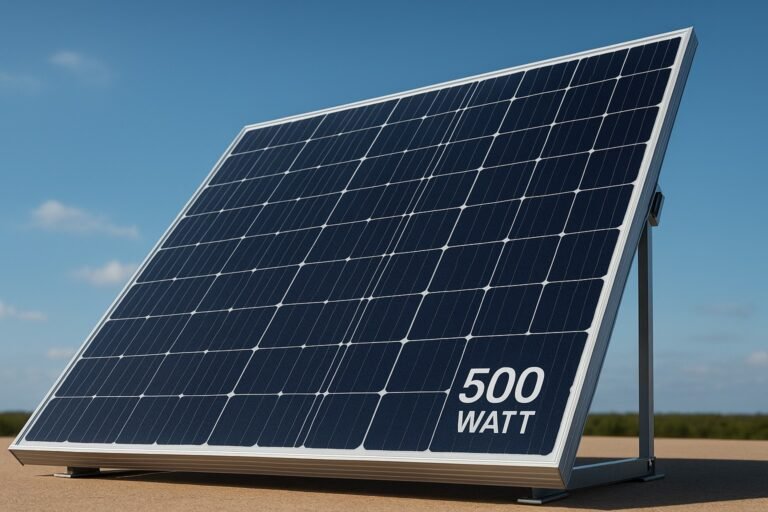
A 500 watt solar panel is one of the most powerful single panels available for residential and small commercial energy systems today. It’s designed to capture sunlight efficiently and convert it into a substantial amount of usable electricity, making it ideal for homeowners, RV users, and off-grid enthusiasts who want to reduce dependence on the grid. As solar technology continues to advance, panels like these have become more compact, affordable, and energy-efficient—allowing users to produce more power with fewer panels.
In this guide, you’ll learn everything you need to know about 500 watt solar panels—from their actual power output and ideal applications to their cost, installation, and long-term performance. Whether you’re planning to set up a small off-grid cabin, upgrade your home’s energy system, or simply understand how these panels compare to traditional ones, this article will walk you through expert-backed insights and practical tips to help you make the right choice.
What Does “500 Watt Solar Panel” Actually Mean?
A 500 watt solar panel refers to a single photovoltaic (PV) module that produces up to 500 watts of power under Standard Test Conditions (STC) — meaning ideal laboratory settings with 1,000 W/m² of sunlight, a cell temperature of 25°C, and clear, unobstructed sunlight. In simpler terms, if your panel operates under perfect weather and alignment, it can generate 500 watts of electricity per hour at its peak performance.
However, in the real world, energy output is rarely constant. A 500 W panel typically generates around 2 to 2.5 kWh per day, depending on location, sunlight hours, orientation, and shading. For instance, homes in sunny regions like Arizona or southern Pakistan may see daily yields closer to the higher end, while cloudy or shaded areas may produce less. Over a year, one 500 W panel can generate between 700 kWh and 900 kWh, contributing significantly to household energy needs.
When compared to smaller panels—like the older 300 W or 400 W options—a 500 W module provides greater efficiency and requires fewer units to reach your target system size. For example, achieving a 2 kW system would take only four 500 W panels instead of six or seven smaller ones. This not only saves roof space but also reduces mounting hardware and wiring costs.
The term “500 watt solar panel size” is equally important because it affects installation and compatibility. These panels are generally larger and heavier than lower-wattage ones, often measuring about 7 to 8 feet long and 3.5 to 4 feet wide, with a weight of around 25 to 30 kg. This means you’ll need adequate roof space and strong mounting support. Understanding these dimensions helps homeowners and installers plan layouts efficiently and ensure structural safety during installation.
Why 500 Watt Panels Are Gaining Popularity
The rise of the 500 watt solar panel is largely driven by major improvements in solar cell technology and manufacturing efficiency. Modern panels now use half-cut cells, bifacial designs, and larger wafer sizes, which allow them to capture more sunlight and reduce energy loss. These advancements boost overall output without requiring much additional surface area, making high-wattage panels more practical for homes and businesses alike.
Another reason for their growing popularity is space optimization. A smaller number of 500 W panels can generate the same total power as many lower-wattage ones, meaning less roof space is needed. This reduction also cuts down on mounting hardware, installation time, and labor costs. Fewer panels mean fewer connection points, simplifying system design and improving long-term reliability.
When it comes to applications, these panels are increasingly favored for commercial and ground-mounted systems, where space and structural capacity aren’t as limited. However, they’re also becoming more common in residential projects with suitable roof layouts. The main consideration for homeowners is handling the larger panel size and ensuring proper mounting strength.
Finally, global market trends show a clear shift toward higher-wattage solar modules. As production technology improves and materials become more affordable, prices per watt continue to drop. This trend makes 500 W panels more accessible than ever, appealing to both installers and end-users seeking efficient, long-lasting, and cost-effective energy solutions.
Are 500 Watt Panels Right For Your Home Or Project?
Choosing a 500 watt solar panel can be a smart decision—but it depends on where and how you plan to use it. These panels deliver high efficiency and strong power output, yet their larger size and weight make them better suited for certain setups than others. Let’s look at how they perform across residential, off-grid, and commercial applications.
Suitability For Residential Roofs
For homeowners, a 500 W panel can be an excellent option if your roof has enough space and can support the added weight. Each panel typically weighs between 25 and 30 kilograms, and because they’re physically larger, proper roof area planning, mounting angle, and structural load assessment are essential. When installed correctly, these panels can help reduce the number of total units needed, simplifying wiring and maximizing your energy generation per square foot.
However, there are some drawbacks to consider. Larger panels can be more challenging to install due to their size and handling requirements. They’re also slightly less tolerant of partial shading—if even a portion is shaded, it can affect the entire panel’s performance. Installers often recommend these panels for wide, open roof spaces where sunlight exposure is consistent throughout the day.
Off-Grid, Mobile, And DIY Applications
In off-grid setups—such as cabins, boats, or RVs—a 500 watt panel offers a compact but powerful energy source. When paired with a 500 watt solar panel kit with battery and inverter, users get a ready-made solution for powering lights, small appliances, or charging batteries. These kits are especially useful for DIY enthusiasts or those living in remote areas, as they simplify the setup process by including all the necessary components.
This makes them perfect for users who want independence from the grid or need reliable backup power. The key is to ensure that the inverter and battery capacity match your energy consumption, especially if you plan to run multiple devices simultaneously.
Commercial And Ground-Mount Installations
In commercial or ground-mounted systems, large-format 500 W and higher panels truly shine. They’re more economical for large-scale projects because fewer panels are needed to reach high system capacities, reducing both installation time and material costs. Commercial spaces and solar farms also have fewer physical constraints, allowing for optimal panel orientation and even integration with tracking systems that follow the sun’s movement for maximum efficiency.
These factors make 500 W panels a top choice for industrial users, agricultural setups, and large properties where performance, efficiency, and cost-effectiveness are top priorities.
Sizing & Planning A System With 500 Watt Panels
Before purchasing any solar equipment, it’s essential to plan the size of your system carefully. A simple way to estimate how many panels you’ll need is to divide your target system size (in kilowatts) by 500 W, the output of each panel. For instance, if you’re aiming for a 4 kW solar system, you’d need approximately eight 500 watt solar panels. It’s always wise to include a small margin—typically 5–10 percent—to account for factors like reduced efficiency, inverter loss, and minor shading.
When designing your setup, consider key variables such as panel orientation, tilt angle, and shading. Panels facing true south (in the northern hemisphere) or true north (in the southern hemisphere) at the optimal tilt for your location will deliver the best results. You’ll also need to match your panels with the correct inverter size and, for off-grid systems, an appropriately sized battery bank.
For those using a 500 watt solar panel kit with battery and inverter, understanding your daily energy consumption is critical. For example, a single 500 W panel paired with a 100Ah lithium battery and a 1 kW inverter can comfortably power small loads such as LED lights, fans, a television, or even a small refrigerator for a few hours daily. Always check your total watt-hour usage and ensure your battery capacity and inverter rating can handle peak demands.
Expert Tip: When planning your solar setup, slightly oversize the DC side (the solar panel array) compared to the inverter capacity. This ensures consistent power production during cloudy weather and provides room for future expansion as your energy needs grow.
Choosing A Quality 500 Watt Solar Panel
Selecting the right 500 watt solar panel goes beyond just wattage. You’ll want to evaluate the panel’s efficiency, cell technology, and long-term performance to ensure a strong return on your investment. Look for advanced cell types such as PERC, half-cut, or TOPCon, which improve power conversion and minimize losses in low-light conditions. Panels with a lower temperature coefficient perform better in hot climates, maintaining efficiency even under high temperatures.
It’s equally important to inspect the mounting and frame quality, as well as the overall panel dimensions and weight, often referred to as the “500 watt solar panel size.” Quality panels will also carry recognized certifications such as IEC 61215 and IEC 61730, which verify durability and safety under international standards.
While many brands now offer modules in the 480–550 W range, some have extended beyond this limit by using larger cells and improved designs. When selecting your panel, prioritize well-established manufacturers that provide solid warranties—ideally 12 years or more for the product and 25 years for performance.
Be cautious with cheaper modules that claim high wattage but have oversized dimensions or lower efficiency, as these can complicate installation and reduce your system’s flexibility.
Personal Tip: From experience, always choose panels from a brand with reliable local support and detailed technical documentation. This ensures easy warranty claims, installation guidance, and long-term service if issues arise.
Integrated Kits: 500 Watt Solar Panel With Battery And Inverter
A 500 watt solar panel kit with battery and inverter is a convenient all-in-one package designed for users who prefer a ready-to-install solar solution. These kits typically include solar panels, a charge controller, a battery bank, a pure sine wave inverter, and all necessary mounting hardware. Some advanced kits even feature pre-configured wiring and connectors, which make installation simpler for beginners or DIY enthusiasts.
The biggest advantage of these integrated kits is convenience and compatibility. Every component is pre-matched in terms of voltage, current, and capacity, ensuring smooth operation and optimal performance. They also save time by eliminating the need to research and source each component separately. Another plus is the faster installation process, since everything is designed to work together out of the box.
However, one limitation of pre-built kits is restricted flexibility. Upgrading the inverter or expanding the battery bank later may not always be straightforward, as the kit’s design is optimized for a specific power range.
For example, an off-grid weekend cabin or RV system using a 500 W panel can easily power LED lights, small fans, a water pump, or even a compact refrigerator when paired with a lithium battery bank and a 1,000–1,500 W inverter. This setup is ideal for users seeking reliable, portable, and clean energy without grid access.
Expert Tip: Always check the technical specifications of your kit before purchasing. Pay close attention to the battery type (lithium or lead-acid), cycle life, and the inverter’s surge capacity—especially if you plan to run appliances with high startup loads like pumps or refrigerators. Matching your load to the kit’s rated output ensures safety, efficiency, and longer equipment life.
Installation & Practical Tips For 500 Watt Panels
Installing a 500 watt solar panel requires a bit more care due to its size and weight. These panels are generally larger than standard modules, so proper handling and mounting safety are crucial. Always have at least two people lift and position the panels to avoid damage or personal injury. Use strong mounting structures that can withstand wind loads and ensure that panels are securely fixed according to the manufacturer’s torque and spacing guidelines.
For wiring and connections, use the correct DC cables, MC4 connectors, and ensure your charge controller is appropriately rated for the panel’s current output. For instance, a single 500 W panel at 24 V may produce around 20–21 A, requiring a controller that can handle at least 25 A for safety.
When it comes to roof mounting, ensure the structure can handle the additional load and that panels are angled to maximize sunlight exposure throughout the year. If space allows, ground-mounted systems or tracking mounts can increase efficiency by automatically adjusting to the sun’s position.
Maintenance is another key factor. Keep your panels clean from dust, leaves, and bird droppings to prevent efficiency loss. Panels perform best when well-ventilated, as trapped heat can reduce output by several percent. Regularly inspect connections and mounting points, especially after storms or heavy winds.
Pro Installer Tip: Schedule an annual inspection of your system to track performance and tighten any loose connections. Monitoring tools or smart inverters can alert you to power drops early, helping you maintain consistent performance over time.
Cost, ROI & What To Expect From A 500 Watt Solar Panel System
The cost of a 500 watt solar panel system varies depending on brand, technology, and installation setup. In Pakistan, a single high-quality 500 W panel typically costs between PKR 45,000 and PKR 65,000, while a complete solar kit with a battery and inverter can range from PKR 150,000 to PKR 250,000, depending on battery type (lithium or lead-acid) and inverter capacity. Globally, these panels are priced between $200 and $400 for the module alone.
A single 500 W panel can generate approximately 700 to 900 kWh annually, depending on sunlight availability and installation quality. In regions like Islamabad, where solar irradiance is strong year-round, this can translate to substantial savings on electricity bills—often PKR 25,000 to PKR 35,000 per year when integrated into a grid-tied system.
Several factors influence your return on investment (ROI), including local electricity rates, the number of sun hours per day, panel orientation, maintenance practices, and whether your system benefits from net-metering. Over time, even modest energy savings accumulate significantly, allowing homeowners to recover their investment within 10 to 15 years, after which the system continues producing free power for another decade or more.
Expert Tip: Treat your solar system like a long-term asset, not a short-term expense. With proper maintenance and high-quality components, a 500 W solar setup can serve efficiently for 25 to 30 years, delivering consistent power and reducing your dependency on rising electricity costs.
Specific Considerations For Pakistan Market (And Similar Climates)
Pakistan’s sunny climate makes it one of the best regions for solar energy adoption. Cities like Islamabad, Lahore, and Karachi receive an average of 5 to 6 peak sun hours per day, offering a clear advantage for users of 500 watt solar panels. This high solar irradiance allows for excellent energy yield throughout the year, maximizing the return on your investment.
However, high ambient temperatures can slightly reduce panel efficiency. When choosing panels, look for models with a low temperature coefficient, as they maintain better output in hot weather. Additionally, local dust and wind conditions mean you’ll need to clean and inspect panels regularly to sustain efficiency.
Other key factors include import duties, local certification, and availability of reliable installers. Before buying, check that your chosen brand offers warranty support within Pakistan and that your inverter is compatible with local grid standards and net-metering regulations. Always verify that your installer is approved by the Alternative Energy Development Board (AEDB) or another recognized authority for compliance and safety.
Expert Advice: Before finalizing your purchase, confirm the system’s compatibility with your area’s net-metering policy, ensure the mounting structure suits local wind conditions, and verify that warranties are honored by local distributors. This due diligence protects your investment and ensures long-term performance.
Future Trends & What’s Next Beyond 500 Watt Panels
The solar industry is evolving rapidly, and the 500 watt solar panel represents just one stage in that progression. Manufacturers are already introducing 550 W, 600 W, and even 700 W modules, thanks to innovations such as TOPCon cells, larger wafer sizes, and bifacial designs that capture sunlight from both sides of the panel. These technologies push efficiency levels higher while reducing the cost per watt.
Beyond higher wattage, the future lies in smart modules equipped with integrated micro-inverters, IoT-based monitoring, and real-time performance tracking. Bifacial panels combined with solar tracking systems are also gaining traction, as they maximize output by following the sun’s movement throughout the day.
From an expert perspective, though, the overall system design often matters more than panel wattage alone. Proper layout, shading analysis, inverter pairing, and installation quality ultimately determine how well a solar system performs over time. As technology advances, the goal isn’t just to chase higher wattage—but to build smarter, more durable, and more efficient solar systems that fit each user’s unique needs.
Conclusion
A 500 watt solar panel is a powerful and efficient solution for those looking to generate clean, renewable energy for their home, business, or off-grid setup. It offers high output, long-term reliability, and cost-effectiveness when chosen and installed correctly. From understanding its real-world energy potential to selecting the right inverter and battery pairing, this technology gives users the flexibility to meet their energy goals while saving space and reducing installation complexity.
Ultimately, the key to getting the most from a 500 watt solar panel lies in thoughtful planning and quality components. Assess your energy needs, ensure proper installation, and seek guidance from certified solar professionals to design a system that fits your environment. With the right setup and regular maintenance, your solar investment can deliver clean power and real savings for decades — a smart, sustainable choice for the future.
FAQ’s:
What Appliances Can A Single 500 Watt Solar Panel Power?
A single 500 watt solar panel can run small household or off-grid appliances such as LED lights, ceiling fans, a television, or a small refrigerator for several hours, depending on sunlight availability and battery storage capacity. However, for high-power devices like air conditioners or water heaters, you’ll need multiple panels or a larger system setup.
How Many 500 Watt Panels Do I Need To Power My Home?
The number of panels depends on your total electricity consumption. For an average home requiring around 4 kW of power, you’d need about eight 500 watt panels. Larger homes or those with heavy appliance usage may require 12–16 panels to achieve full energy independence.
Can I Use A 500 Watt Solar Panel With A 12-Volt Battery System?
Yes, but you’ll need a compatible charge controller (preferably an MPPT controller) that can safely convert the panel’s higher voltage to suit a 12 V battery system. It’s important to match your battery’s capacity and ensure proper wiring to avoid overcharging or inefficiency.
Are 500-watt Solar Panels Suitable For Off-Grid Applications?
Absolutely. These panels are excellent for off-grid setups like cabins, RVs, boats, or remote farms. When paired with an inverter and a suitable battery bank, they can power essential loads reliably, offering independence from the utility grid.
What Should I Check Before Buying A 500 Watt Solar Panel Kit?
Before purchasing, review the technical specifications, including inverter capacity, battery type, and total system compatibility. Ensure the kit includes high-quality components, such as certified panels, a reliable inverter, and a long-life battery. Also, verify warranty terms, local support availability, and installation compatibility with your setup to guarantee long-term performance and safety.
Disclaimer
The information provided in this article is for educational and informational purposes only. It should not be taken as professional engineering or installation advice. Always consult a licensed solar installer or certified electrician before purchasing or setting up any solar equipment. Product specifications, pricing, and performance may vary based on location, manufacturer, and system design.
